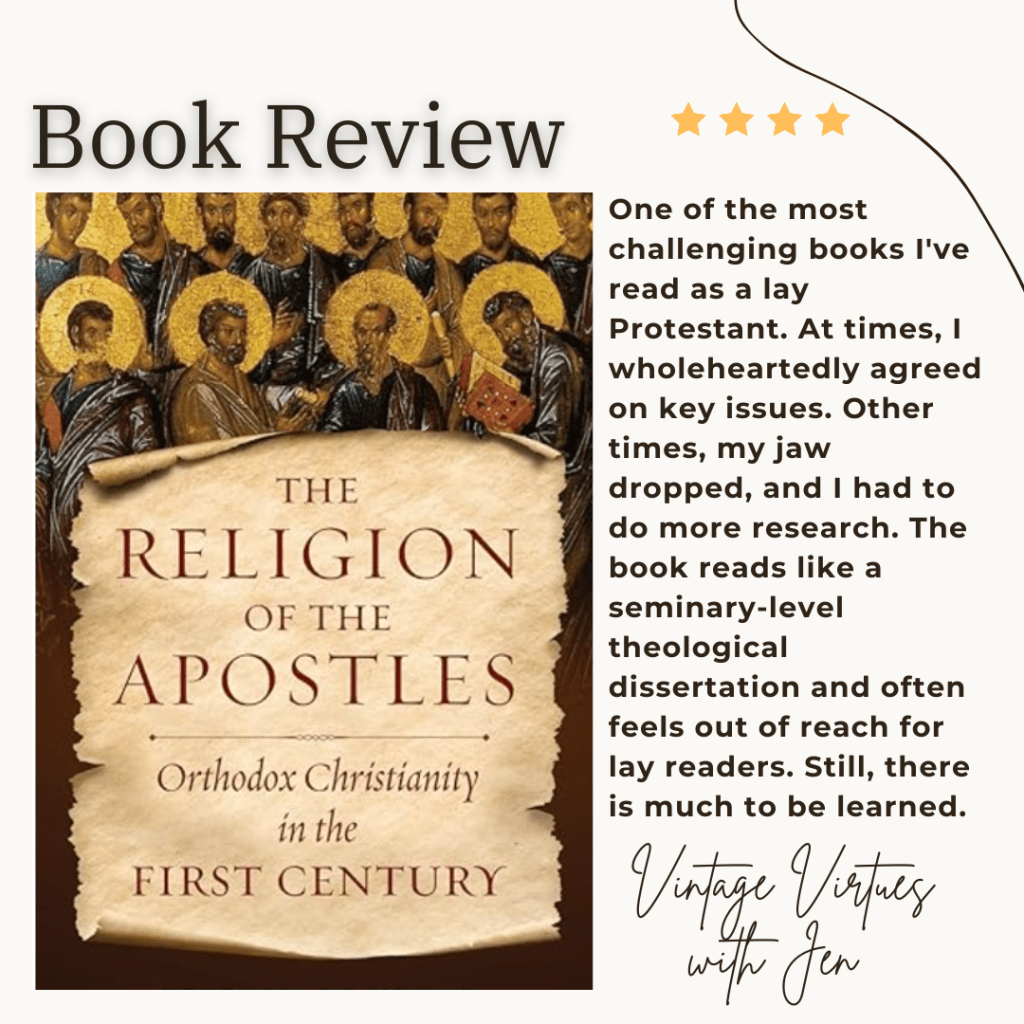
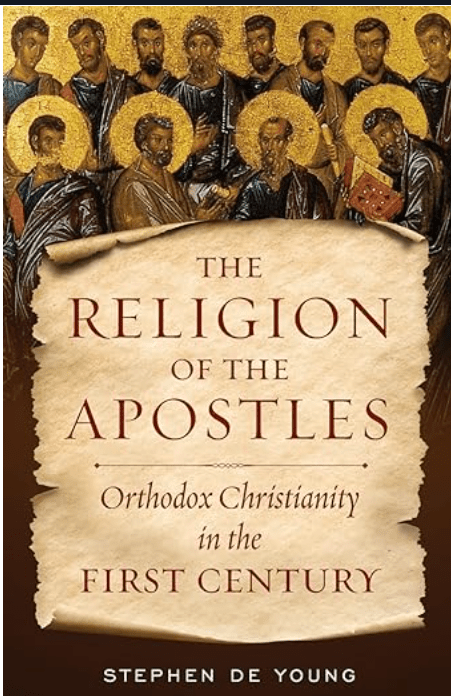
A Book Review of Religion of the Apostles: Orthodox Christianity in the First Century by Father Dr. Stephen De Young
About the Author
Father Dr. Stephen De Young pastors Archangel Gabriel Orthodox Church (Antiochian) in Lafayette, Louisiana. He holds a PhD in Biblical Studies from Amridge University. Father Stephen hosts the Whole Counsel of God podcast and co-hosts the Lord of Spirits podcast on Ancient Faith Radio. He also writes The Whole Counsel Blog on the Ancient Faith Ministries website.
Synopsis
Stephen De Young’s The Religion of the Apostles offers a theological deep dive into what the Orthodox Christian Church claims is the continuation of the apostles’ religious life. This book challenges the notion that Christianity was a new religion divorced from its Jewish roots. Instead, Father De Young argues that the Orthodox Christian Church of today maintains the lineage of Orthodox Christianity through an unbroken continuation of the life of the people who witnessed the risen Christ.
The work is divided into four main parts: The Godhead, God’s Divine Council, Creation & Salvation, and God’s People and His Law. Each section builds upon the previous one to construct a comprehensive picture of the Orthodox Christian perspective on early Christianity and its connection to Second Temple Judaism.
This is probably one of the most challenging books I’ve read as a lay Protestant curious about Orthodox Christian beliefs. At times, I found myself wholeheartedly agreeing on some primary issues, while at other times I dropped my jaw and did a deeper dive into research to wrap my mind around some concepts. The book reads like a seminary-level theological dissertation and, at times, feels out of reach for lay readers without significant background in biblical studies or church history.
Key Points
- Explores trinitarian doctrine through the lens of Second Temple Judaism and the Jewish worldview of the time of Christ
- Breaks down the divine council concept and the Deuteronomy 32 worldview, drawing on the Dead Sea Scrolls
- Examines spiritual warfare, the “three falls” of death, sin, and the domination of the world by fallen principalities and powers
- Traces the theology of atonement, propitiation, and expiation, framing the debt of sin as death
- Discusses the veneration of saints and the role of Mary as Theotokos
- Covers baptism, the reception of the Holy Spirit, and the Orthodox faith life
- Addresses the law of God and how it applies to Christians today, including the Sabbath and biblical feasts
- Explores what constitutes Israel, the remnant, and the continuity between the old and new covenants
- Includes a 3-page bibliography, scriptural references, and an alphabetized topical reference guide
Strengths
- Father De Young’s biblical scholarship shines throughout this work; his ability to connect Second Temple Judaism with the practices and beliefs of the New Testament church provides valuable insights often missing from modern Christian discussions.
- The author does a thorough job of communicating what the Orthodox church faith entails and seems to write intuitively, with potential audience questions already in mind
- The discussion of spiritual warfare and the reality of principalities and powers offers a needed corrective to many modern Christian perspectives that have sanitized or ignored these biblical realities.
- Father De Young successfully demonstrates that early Christianity was not a break from Judaism but a fulfillment of it, albeit in ways that many Jews of that time did not accept
Weaknesses
- The book’s academic tone and dense theological content make it challenging for the average reader; it demands significant concentration and often requires additional research to fully grasp the concepts presented.
- Some arguments rely heavily on extrabiblical sources like the Book of Enoch and pseudepigraphal works attributed to figures like St. Dionysius, which may be problematic for readers who hold to sola scriptura
- The book doesn’t always adequately address potential contradictions or alternative interpretations, such as how fallen angels governing nations squares with God’s sovereignty
- Certain Orthodox practices, such as the veneration of saints and lengthy catechumen processes, seem at odds with the biblical examples of immediate conversion and baptism following belief.
- The distinction between worship of our Triune God and veneration of Mary and the Saints may strike some readers as unnecessarily complex when Scripture seems to draw clearer lines about worship and mediation.
Personal Reflection
Part 1: The Godhead
I appreciated learning more about why the Orthodox Church, and other more liturgical traditions such as Roman Catholicism, are set up the way they are. The altar setup in Orthodox and Catholic churches features a veiled, obscured view, and I wondered why it’s set up that way. I did further research and found it’s meant to set the mind on worship; even Protestants started with altars, and some still do “altar calls,” but soon the altar was replaced with a stage, and hymns and liturgy were replaced with sermons and praise bands. I thought about how at Jesus’ death, the veil in the temple was torn.
I found myself agreeing with the majority of the first part of the book on the Godhead. I’ve seen many of the examples given for myself in Scripture, and I appreciate the breakdown of where we see the presence of God, His Spirit, and His Name in both the Old Testament and New Testament, as well as appearances of the Angel of the Lord. I also appreciate the clarity that the Sabbath is Saturday and that Sunday meeting is on the first day of the week, in honor of the day our Savior rose, the eighth day. Some Protestant circles seem to have different perspectives on what those days mean.
Part 2: God’s Divine Council
This section presents one of the book’s more challenging aspects. I’ve heard of the divine council from Scholar Michael Heiser, and also within Christian discussions on the Book of Job. This section breaks down the Deuteronomy 32 worldview by citing what it claims is correct Hebrew wording from the Dead Sea Scrolls about Deuteronomy 32, saying the nations were divided out to fallen angels, “according to the number of the sons of God.” This is hard for me to reconcile with Satan and his angels being chained up in the abyss. It’s equally hard for me to understand why so much evil still prevails if they’re chained up and being subject under the feet of Christ.
I found Satan’s description in Ezekiel 28 most compelling, as it ascribes his characteristics to King Tyre. But the section as a whole left me with more questions and confusion, as it doesn’t fully align with the biblical narrative as I understand it. I wondered how the Saints and Angels, as servants, fit into the narrative of leadership or influence, when all things are subject to Christ, our Sovereign Lord.
I thought more about iconoclasm and the veneration of Saints, as well as the practice of praying to Saints. These practices feel like they raise Saints and Angels to the level of God, which seems to overstep the boundaries of the commandment against idolatry, along with the prohibition against worship of angels in Colossians 2:18. Though I did read that Orthodox and Catholics draw a firm line between Latria (Worship of God alone) and Dulia (veneration or honor to Saints and Angels), it seems like such a fine line, when there is only one mediator between God and man: Christ Jesus (1 Timothy 2:5).
The section on spiritual battle is the most interesting, and I don’t think enough Protestants truly understand it. Talk of angels and demons is often left to the Catholics and horror movies. I also like the explanation of the “three falls”: death, sin, and the domination of the world by fallen principalities and powers. We talk about how Jesus conquered death, sin, and the grave, but not much about the principalities and powers, all things that He has put in subjection under His feet (1 Cor 15:27 and Eph 1:22).
I truly respect the blessed and highly favored Mother Mary, referred to as Theotokos, and I believe she was a Virgin and gave birth to our Lord and Savior Jesus Christ. I struggled with a few Orthodox dogmas, such as her perpetual virginity after Jesus’ birth, given that she was married and Jesus had siblings, and with the concept of her being a mediator, since 1 Timothy 2:5 says there is one God and one mediator between God and men, Jesus Christ. I have no issue referring to the saints, acknowledging them as alive eternally, a great cloud of witnesses cheering us on, and I even understand venerating. Still, mediating is a role reserved for Christ.
Part 3: Creation & Salvation
My understanding comes from the perspective that God exists outside time, space, and matter, and that He created everything from nothing. I had never considered Gen 3:21 about God making coats of skins for Adam and Eve to mean that He put mortal flesh onto their once immortal bodies. I’ve never considered it as being more than them putting on clothes after realizing they were naked. That’s an interesting perspective.
I found the discussion on how pagans created idols and tried to invoke spirits into them educational; it helps show why God prohibits and combats this idolatry throughout Scripture. The book also touches on the cycle of feasts, such as the Ascension of Christ and Pascha, and I wonder why some biblical feasts, such as Pascha (Passover), are celebrated while others, like the Feast of Booths (Sukkot), aren’t.
The author dives into the theology of atonement and debates surrounding propitiation and expiation, framing the debt of sin as death, with Christ as the victor over death and judge. The author uses the Book of Enoch’s words about Azazel to develop the Orthodox position on atonement, which is a stumbling block for me, specifically because in chapter 71 of the Book of Enoch, an angel refers to Enoch as the Son of Man, which is Jesus’ identity.
Part 4: God’s People and His Law
I’m still not quite clear on the concept that the nations were scattered and given to the governance of fallen angels, brought up again in this section of the book. It further leads into the idea that God created a new nation for Himself, Israel. This seems to contradict the clear genealogy records that show Abraham as the tenth-generation descendant of Noah; the promise of a nation was given to Abraham, which eventually came through Jacob, who was renamed Israel. This is not a new nation but a fulfillment of promise.
I do think it’s important that the author recognized that Israel was composed of a mixed multitude, with foreigners who joined themselves to Israel. I disagreed with the author’s premise that the promise of restoration isn’t for all Israel and Judea, only for the Northern Kingdoms. I’ve heard this theory before, but it contradicts Ezekiel 37:15-28, where God tells Ezekiel that the two sticks in his hand represent Israel and Judah, and that He plans to join them as one and bring them back to their land.
I appreciate the length and depth of the writing in expressing the importance of the Passover, Pascha, and Christ as our Passover Lamb, and in highlighting the importance of sacraments such as the Eucharist and Baptism. This is one area where I feel some modern Evangelical Protestant churches have lost the plot. We may celebrate Easter, but it’s often laced with egg hunts and bunnies, with only brief reference to the crucifixion of Jesus, and much of the Passover’s redemptive storyline is lost.
I wholeheartedly agree with the author that under the New Covenant, knowing God rather than just knowing about Him is offered to every person who has received the Holy Spirit. The Lord no longer dwells in a temple built by human hands, but Jesus left with us the deposit of the Holy Spirit to guide us into all truth. 3,000 souls received the Holy Spirit on the day of Pentecost, and whole households were baptized immediately upon hearing the gospel.
So it leaves me in tension when I see a three-year catechumen and baptismal process before a person is even eligible for communion in the Orthodox Church. What do we make of the Ethiopian who heard the gospel and immediately asked to be baptized at the first bit of water in sight? Or the thief on the cross promised paradise by Jesus Christ? I’m not criticizing the Orthodox church, but rather expressing sorrow over man’s judgment of worthiness over men whom God has accepted and justified.
I think chapter 9, the Law of God, is important, especially in how the law applies to Christians today. Most will agree that Christ’s blood fulfilled most of the laws of the sacrificial system, but there’s still debate about how much of the ceremonial, civil, and moral laws still apply. I also agree with the author that the categories of civil, ceremonial, and moral that John Calvin put forth are not categories recorded in Scripture.
Jesus came to fulfill the law, not abolish it, to show it can be done. Yet it seems the Gentiles are freed to ignore large swaths of the law. If the law was so important, how can neglect of it now provoke the Jews to be jealous when they were made to keep the law? It just seems like it could come across as contradictory, insincere faith from Gentiles.
I do appreciate the elaboration on who Israel is, or rather who the remnant are. It’s composed of those who followed Christ. I also easily understood how the structure Christ put in place with twelve apostles and seventy followers paralleled the Old Covenant’s patriarchs and elders under the leadership of Moses, building a stronger case for apostolic succession.
Final Thoughts
Religion of the Apostles offers a strong contribution to the literature on Orthodox Christianity and its relationship to early church history. Father Stephen De Young demonstrates scholarship and makes a compelling case that modern Christians have much to learn from understanding the continuation of the apostles’ religious life.
However, the book’s weaknesses cannot be ignored. Its reliance on extrabiblical sources, incomplete engagement with alternative views, and sometimes speculative arguments about fallen angels and the divine council detract from its stronger elements. The gap between the immediate baptisms and Spirit-filling described in Acts and the lengthy catechumen process of modern Orthodoxy deserves more attention.
For readers willing to engage critically with the material, this book offers a valuable window into Orthodox Christian thought and practice. It challenges superficial Christianity and calls believers to a deeper, more historically informed faith. At the same time, readers should approach the work with discernment, testing all claims against Scripture and being willing to disagree where the evidence doesn’t support the author’s conclusions.
My Experience at an Orthodox Church
If you’ve liked the content in this article, why not subscribe to our newsletter to get more Christian-based book reviews. At Vintage Virtues, we’re all about homesteading, homemaking, and homeschooling from a Biblical perspective. I’ve also included a video below in which I talk about my visit to an Orthodox Christian church.
Affiliate Disclosure
This post contains affiliate links. As an Amazon Associate and affiliate of other brands, I may earn a small commission from qualifying purchases. This costs you nothing extra and helps support Vintage Virtues’ work. Thank you! See full Affiliate Disclosure here.
Source Citation
De Young, Stephen. The Religion of the Apostles: Orthodox Christianity in the First Century. Ancient Faith Publishing, 2021.
“Religion of the Apostles Book Review | Orthodox Christianity” Copyright © 2026 Vintage Virtues. All rights reserved. No portion of this review may be reproduced without express written permission


Leave a Reply