
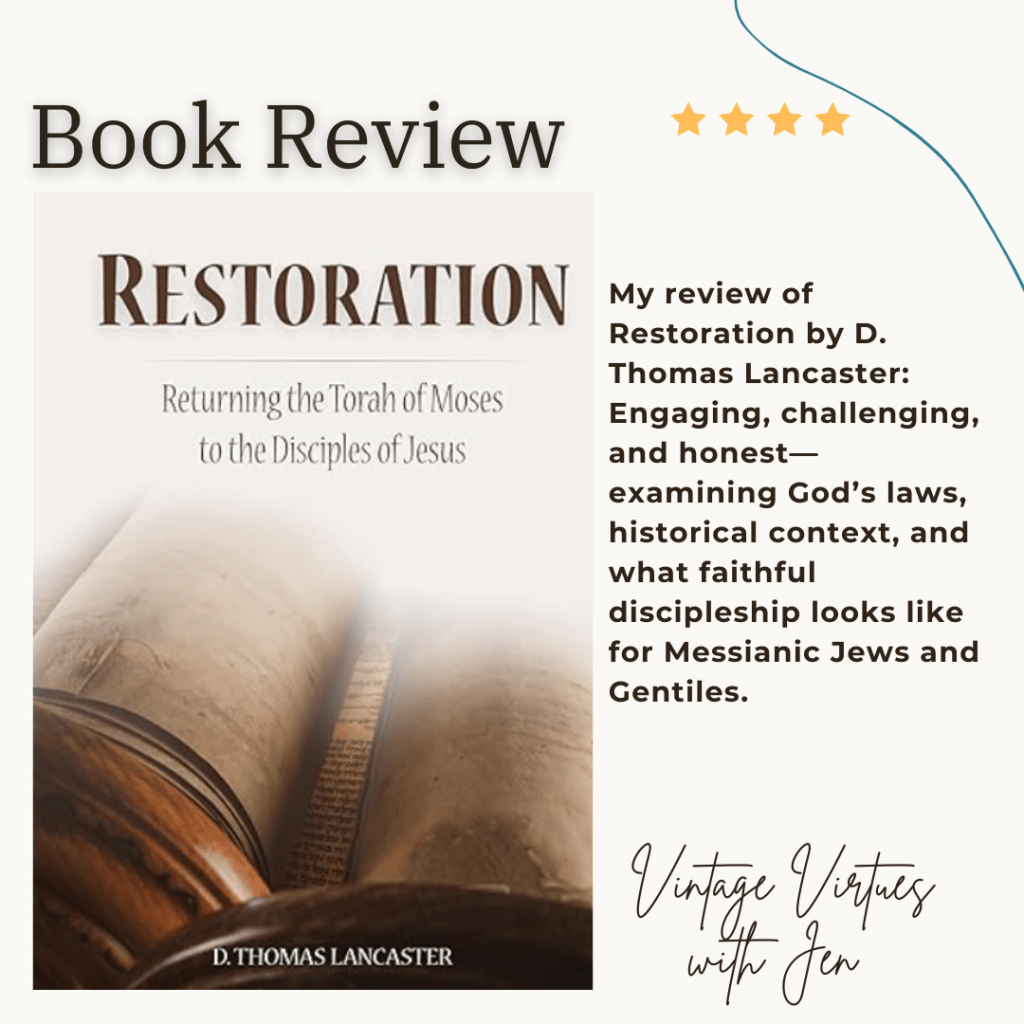
I’d like to preface this review by noting that I was gifted a copy of Restoration: Returning the Torah of Moses to the Disciples of Jesus by First Fruits of Zion. All opinions expressed here are my own, based on my reading and reflection. My thoughts do not constitute a professional endorsement of the organization.
About the Author
D. Thomas Lancaster is an author and Educational Director for First Fruits of Zion (FFOZ), a messianic Jewish education organization dedicated to restoring the Jewish foundations of the Christian faith through teaching, publishing, and discipleship programs, such as Torah Club. Lancaster is also a frequent guest on “Messiah Podcast” and the principal teacher at Beth Immanuel Messianic Synagogue.
Synopsis
In Restoration: Returning the Torah of Moses to the Disciples of Jesus, D. Thomas Lancaster explores how the Torah remains relevant for both Messianic Jews and Gentile believers in Christ. He shares his personal journey—from a non-denominational, fundamentalist upbringing to discovering the Messianic Jewish faith through his brother’s studies in Israel, which shaped his brother into his mentor. Lancaster credits Messianic Judaism with salvaging his faith, deepening his understanding through mentorship, synagogue life, and study with First Fruits of Zion. His passion for sharing the profound beauty of Torah life is evident throughout the book.
The book weaves together personal testimony and historical narrative, showing how early Christianity was rooted in Torah observance. Lancaster traces the lives of Jesus, the disciples of Christ Jesus (Messiah Yeshua), and Paul, Jewish believers, highlighting their celebration of the biblical Sabbath and God’s appointed feasts / Holy Days, and their commitment to God’s commands. He then explains how, over time, the early church drifted from these foundations through the influence of church councils, prominent leaders, and pivotal historical events that separated Christians from their Jewish heritage.
With clear teaching on Torah, the Old and New Covenants, and the practical implications of biblical obedience, Lancaster invites readers to rediscover the richness of Torah life. His call is both simple and challenging: to read the Scriptures Jesus read, to embrace their historical context, and to live out one’s faith with deeper intentionality.
Key Points
- Lancaster’s Background and Journey: The book opens with Lancaster’s personal story—growing up in a non-denominational, fundamentalist church, attending an Evangelical Free Church, and eventually discovering Messianic Judaism through his mentor brother and FFOZ studies. This personal journey gives context for why the book is called Restoration: it salvaged his faith.
- Early Christianity as Torah-Observant: Lancaster argues that Jesus, the disciples of Messiah Yeshua (Christ Jesus), and Paul were Jewish people and adhered to the Torah. Gentile believers were grafted into this covenantal community, a key point for understanding the integration of Jews and Gentiles in God’s plan, while holding to the mystery of the gospel.
- Historical Separation from Judaism: The book traces how early Christians were expelled from synagogues, how church councils (Nicaea, Laodicea, and Antioch) prohibited Sabbath and Passover observance, and how leaders such as Constantine and Martin Luther distanced Christianity from its Jewish roots.
- Definition and Application of Torah: Lancaster defines Torah as the first five books of the Bible, contrasting it with the Old Covenant (Torah without the Messiah) and the New Covenant (Torah written on the hearts through the Messiah). He emphasizes that disciples should read the same Scriptures Jesus read and follow God’s commands as a biblical expression of faith.
- Practical Teaching on Obedience: The book emphasizes the Sabbath, biblical feasts, baptism, and obedience to God’s law as essential aspects of discipleship. Lancaster offers a critique of traditional interpretive paradigms, arguing that many modern Christians have effectively discarded God’s commandments—a tendency he calls “editing God.” Instead, he urges believers to recover a Torah-observant mindset that aligns with the practices of Jesus and the early disciples.
- Points of Theological Debate: Lancaster engages with controversial topics, including Paul’s letter to the church in Acts, the applicability of the Torah to Gentiles as discussed in Acts 15 and the Noahide Laws, and the relationship between law and the Messiah. He also challenges misconceptions that Jesus or Paul ever broke God’s law.
Strengths
- Historical Context: Lancaster’s recounting of early Christianity as a sect of Judaism, including expulsions from synagogues, anti-Jewish sentiments from leaders like Justin Martyr, and the actions of Constantine and Martin Luther, was eye-opening. It helped me understand how Christianity gradually separated from the Torah-observant roots of its first disciples, with the Reformation’s impact on the Roman Catholic Church playing a key role.
- Emphasis on Torah and Obedience: The book clearly demonstrates that Jesus, the disciples of Yeshua, and Paul adhered to the Torah, observing the biblical Sabbath and feasts. This grounds the teaching of biblical Christianity in real historical practice, with relevance for real people today and for future generations.
- Practical Applications: Lancaster encourages readers to read the Scriptures that Jesus read—the Old Testament—and apply God’s commands in daily life. His discussion of baptism and Sabbath observance made these practices feel culturally and spiritually meaningful.
- Challenge to Assumptions: He effectively addresses common theological objections, such as claims that Jesus or Paul broke God’s law, prompting readers to reconsider long-held interpretations.
- Accessible Presentation: Definitions of terms and explanations of Torah and covenant concepts make this an easy-to-read book, even when handling complex historical or theological topics.
Weaknesses
- Terminology Confusion: Lancaster frequently substitutes “Torah” for “law,” even in contexts where “law” would be more precise. This can be confusing, as the Torah also includes narratives, genealogies, and teachings that extend beyond the moral law.
- Speculative Interpretations: Some points extend beyond Scripture, such as the use of apocryphal texts, rabbinic writings, or extra-biblical reading (e.g., Solomon) to illustrate key points. These can distract from a sola scriptura foundation.
- Noahide Laws Stretch: Interpreting events in the Book of Acts, particularly in chapter 15, as evidence that Paul essentially supported Noahide Laws seems speculative and not directly supported by Scripture.
- Holy Spirit Phrasing: Describing the Holy Spirit as “a Torah-observant Jewish person dwelling within you” felt awkward and potentially misleading.
- Complexity for New Readers: The depth of historical and theological discussion—especially regarding gentile participation, Torah observance, and early church councils—may overwhelm readers who are newer to Messianic Jewish teachings or unfamiliar with this perspective.
Personal Reflection
Reading Restoration was both engaging and challenging. I especially appreciated Lancaster’s historical insights—particularly his explanation of how early believers faced persecution from both Jews and Romans, and how the church gradually distanced itself from its Jewish roots. At the same time, his framing of Gentile participation as being grafted into Judaism rather than into Christ felt at odds with my understanding of Romans.
I was drawn to his discussion of Torah, the Sabbath, and biblical feasts, and how these practices are rooted in the life of Jesus and His disciples. It reminded me that biblical Christianity is not just a belief, but a lived, obedient faith, tied to God’s moral law and all of Scripture, encompassing both Old and New Testament teachings.
At the same time, I struggled with some of Lancaster’s terminology choices, particularly his use of “Torah” to replace “law,” and his interpretation of Acts 15 through the Noahide framework, which seemed speculative. I also found his phrasing about the Holy Spirit as “a Torah-observant Jewish person dwelling within you” unusual, though I understood his intention to connect believers to God’s heart for Torah.
Overall, the book prompted me to reflect on the role of the law in the believer’s life, the importance of historical context, and how obedience and understanding Scripture can deepen both faith and discipleship in real time. It is a thought-provoking, practical call for anyone seeking to engage more deeply with the Scriptures Jesus read and to appreciate the continuity between the Old and New Testaments.
FFOZ has been seen as a theological boat-rocker for its past one-law theology, which earned it the (inaccurate) Hebrew Roots label in some circles. They’ve long since recanted those views, addressed misconceptions, and have been consistent with their current stance. For example, see their FFOZ Reacts podcast episode, Is the Church Preaching an Incomplete Gospel? Their views are theologically nuanced, and this article may help clarify their understanding: Does FFOZ Teach Gentiles to Observe the Torah?
Final Thoughts & Recommendation
Restoration: Returning the Torah of Moses to the Disciples of Jesus, D. Thomas Lancaster is a thoughtful and challenging work that invites readers to reconsider what it means to follow Yeshua in light of the Torah and the whole of Scripture. Blending personal experience, historical context, and practical teaching, Lancaster highlights the continuity between the Old and New Testaments while pointing to the enduring beauty of Torah life.
Some interpretations—such as using “Torah” in place of “law” or connecting Acts 15 to the Noahide principles—require discernment, but the book as a whole serves as a practical call to engage Scripture deeply, pursue obedience to God’s commands, and appreciate the historical roots of Christianity.
I recommend Restoration to those interested in the Jewish roots of the Christian faith, Messianic Jewish perspectives, disciples seeking a deeper connection to God’s commands, or anyone curious about how the first believers lived out their faith. Lancaster’s work encourages both reflection and action, making it a valuable resource for Torah Club students and any believer eager to explore how Torah shapes faithful living today.
Source Citation
Lancaster, D. Thomas. Restoration: Returning the Torah of Moses to the Disciples of Jesus. First Fruits of Zion, 2015.
Affiliate Disclosure
This post contains affiliate links. As an Amazon Associate and affiliate of other brands, I may earn a small commission from qualifying purchases. This is at no extra cost to you and helps support the work of Vintage Virtues. Thank you! See full Affiliate Disclosure here.
“Restoration” Torah for Disciples by Lancaster: Book Review
Copyright © 2025 Vintage Virtues. All rights reserved. No portion of this review may be reproduced without express written permission.
 Vintage Virtues
Leave a comment